
Home › Guides › Gold Making Charges
Updated 22 October 2026 · Source: All-Pakistan Sarafa Association
Gold Making Charges in Pakistan: What Is Fair?
Making charges (mazdoori) are the jeweller’s fee for turning gold into jewellery, added on top of the gold rate. In Pakistan they are quoted either in rupees per tola or as a percentage, commonly about 3% to 20% depending on design. At today’s 22K rate, 10% equals about Rs39,832 per tola.
What Are Making Charges?
Making charges are the labour and workshop cost of designing, casting, soldering, setting and polishing a piece of jewellery. They are separate from the value of the gold itself, which is set by the day’s Sarafa rate. In Urdu they are usually called mazdoori or banwai.
The gold rate is the same in every shop in Pakistan, so making charges are the main reason two jewellers quote different prices for similar pieces. Knowing how they work is the easiest way to save money.
How Jewellers Quote Making Charges
| Method | How it works | Common at |
|---|---|---|
| Rupees per tola | A fixed amount for each tola of gold, e.g. Rs15,000 per tola | Traditional bazaar jewellers |
| Percentage of gold value | A share of the gold price, e.g. 10% of the 22K value | Branded showrooms, larger stores |
| Rupees per gram | A fixed amount per gram, common for light or 18K pieces | Branded and diamond jewellery |
| Fixed price per piece | One all-in price, with gold and labour not shown separately | Some branded and online stores |
A percentage charge rises automatically when the gold price rises; a per-tola charge does not. Always ask the shop to convert its quote into rupees so you can compare like with like.
Making Charges: Percentage vs Rupees per Tola Today
At today’s 22K rate of Rs398,325 per tola, here is what each percentage means in rupees:
| Making charge | Per tola (22K) | On a 2-tola set | On a 5-tola bridal set |
|---|---|---|---|
| 3% | Rs11,950 | Rs23,899 | Rs59,749 |
| 5% | Rs19,916 | Rs39,832 | Rs99,581 |
| 8% | Rs31,866 | Rs63,732 | Rs159,330 |
| 10% | Rs39,832 | Rs79,665 | Rs199,162 |
| 12% | Rs47,799 | Rs95,598 | Rs238,995 |
| 15% | Rs59,749 | Rs119,497 | Rs298,744 |
| 20% | Rs79,665 | Rs159,330 | Rs398,325 |
Example: a jeweller quoting Rs15,000 per tola is charging about 3.8% at today’s rate.
Typical Making Charge Ranges in Pakistan
Charges vary by city, shop and design, so treat these as rough guides that buyers commonly report, not fixed rates:
| Type of item | Typical range | Why |
|---|---|---|
| 24K bars and coins | 0%, plus a small dealer premium | No design work |
| Plain chains and simple rings (machine-made) | About 3% to 8% | Mass production keeps labour low |
| Bangles and standard jewellery | About 5% to 10% | Some hand finishing |
| Handmade and detailed work | About 10% to 15% | Skilled labour and time |
| Bridal sets, kundan and stone-set pieces | About 12% to 20% or more | Complex work, stones, setting |
| Branded and designer jewellery | Often higher; sometimes included in a fixed price | Brand, design and showroom costs |
Hidden Charges to Watch For
- Stones weighed as gold: make sure the gold rate is charged only on the net gold weight, not on stones, beads or lac filling.
- Wastage or polish charges: some shops add a percentage for metal lost during making. Ask whether it is included in the making charge.
- Rounding the karat rate: using 24K × 0.916 vs 22 ÷ 24 or rounding up can add a few thousand rupees.
- Tax: larger retailers may add sales tax; ask whether the quote includes it.
- Card charges: some shops add a fee for card payments.
Making Charges Are Lost When You Sell
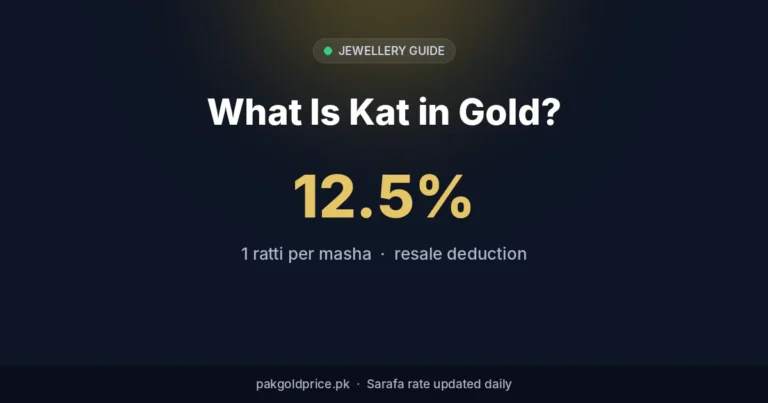
When you sell jewellery, the buyer pays only for the gold, minus kat. Making charges are not refunded. For a 2-tola 22K set bought today with 12% making:
| Amount | |
|---|---|
| You pay (gold + 12% making) | Rs892,247 |
| You get back (gold − 12.5% kat) | Rs697,068 |
| Difference | Rs195,179 (22% of the price) |
This is why 24K bars are better for saving, and why jewellery is best bought to wear and keep. More on kat when selling.
What Is a Fair Making Charge?
- Get three quotes for the same design and weight, converted into rupees.
- Match the charge to the work: a plain machine-made chain should not carry a bridal-set charge.
- Negotiate on labour, not gold: the gold rate is fixed by the market; the making charge is where shops have room.
- Ask about exchange: some jewellers reduce making charges when you trade in old gold.
- Get it in writing: the bill should show gold weight, karat, rate, making charge, any tax and the total.
Calculate Your Jewellery Price
Enter the weight and the jeweller’s making charge per tola to see the full price:
Gold Making Charges: Frequently Asked Questions
What are making charges on gold?
The jeweller’s fee for labour and workshop costs to make a piece of jewellery, added on top of the gold rate.
How much are gold making charges in Pakistan?
Commonly about 3% to 8% for simple machine-made pieces, 10% to 15% for handmade work and 12% to 20% or more for bridal and stone-set jewellery. They vary by shop.
How do I convert making charges per tola into a percentage?
Divide the charge by the gold rate per tola. Rs15,000 on 22K today is about 3.8%.
Are making charges refunded when I sell gold?
No. Jewellers pay only for the gold content, minus kat.
Do gold bars have making charges?
No making charges, but dealers usually add a small premium over the gold rate.
Can I negotiate making charges?
Yes. Making charges are the main part of a jewellery price that shops can adjust; compare several quotes.
Why do branded jewellers charge more?
They include design, certification, showroom and brand costs, often as a percentage or in a fixed price.
What is mazdoori?
Mazdoori is the Urdu term for the making or labour charge on jewellery.
Related Gold Rates and Tools
Rates are for information only and exclude making charges, kat and dealer premiums. Not investment advice. See our disclaimer and methodology. Official daily rate source: All-Pakistan Sarafa Gems and Jewellers Association rates (Business Recorder).

One Comment
Comments are closed.